A Brief Guide for Better Construction Site Supervision

Construction is one of the leading industries in the United Arab Emirates, which is touching new heights of progress with every passing day. However, the industry is not free of common issues and problems. The most notable among them is the construction accidents that take place due to poor site management.

Paying attention to all the major and minor site details is the responsibility of construction stakeholders. The site supervision tips and ways can prove guiding light for them. Still, uncertainty is the part of the construction industry that can lead to claim and dispute issues. So, hire construction quantum experts and include them in your project from the get-go to collect the evidence and present your case in the time of need.

Manage your construction site professionally to reduce the issues and consult the experts to manage your claim and dispute issues without wasting time.

Construction Site Supervision - A
ll

Do You Know?

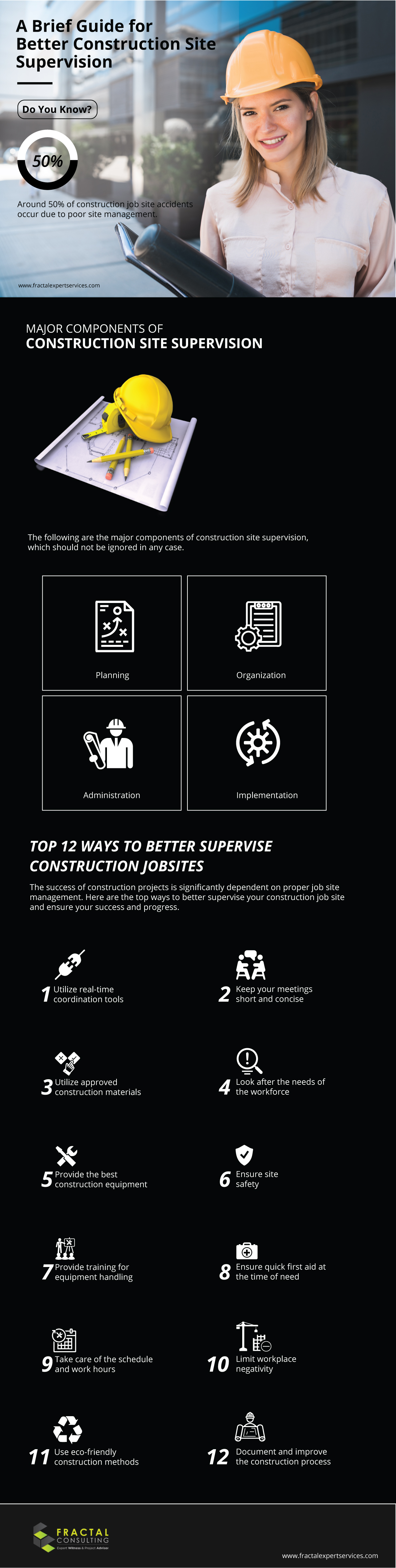
Around 50% of construction job site accidents occur due to poor site management.

Major Components of Construction Site Supervision

The following are the major components of construction site supervision, which should not be ignored in any case.

  • Planning
  • Organization
  • Administration
  • Implementation

Top 10 Ways to Better Supervise Construction Job sites

The success of construction projects is significantly dependent on proper job site management. Here are the top ways to better supervise your construction job site and ensure your success and progress.

  1. Utilize real-time coordination tools
  2. Keep your meetings short and concise
  3. Utilize approved construction materials
  4. Look after the needs of the workforce
  5. Provide the best construction equipment
  6. Ensure site safety
  7. Provide training for equipment handling
  8. Ensure quick first aid at the time of need
  9. Take care of the schedule and work hours
  10. Limit workplace negativity
  11. Use eco-friendly construction methods
  12. Document and improve the construction process

Final words!

Pay attention to all the little details of your constriction job site and ensure its proper management and supervision. The right work atmosphere will boost productivity, and the progress of the project.

Construction Site Photography – All You Need to Know

Construction is one of those industries of the world that can face drastic changes in matter of a few minutes. A little mistake can lead to huge losses and destruction. Therefore constant monitoring is crucial in this industry.

Documentation is not enough to record all the little details in this advanced era. The solution is photo documentation, which focuses on taking detailed photographs of the construction job site on a routine basis. Photo documentation of construction projects helps deal with claim and delay issues smoothly.

However, if you have neglected photography of the job site in the past and are facing claim issues, you can hire the service of construction claim consultants in Dubai and let them provide your expert guidance and support in the light of the evidence and current circumstances. Prioritize photography of your job site and involve the experts to deal with all the major or minor issues without causing any disruption in work.

Construction Site Photography - All You Need to Know

Construction job site photo documentation is not new or common to modern society. However, it has become an important need due to which it is getting popular in developed countries like the United Arab Emirates.

Benefits of Photo Documentation of Construction Site

The following are some crucial benefits of photo documentation of the construction site.

  • Proof against claims
  • Error-free field reporting
  • Constant site updates for higher management
  • Lots of marketing opportunities
  • A visual timeline of site progress
  • Boost in quality control
  • Paves the way for approval of change orders
  • Evidence of all little details
  • Boost communication
  • Show achievement of project milestones

Photography Options for Construction Jobsites

Here are some of the most common photography options for the construction job site.

  • Smartphone photography
  • Tablet photography
  • Drone photography
  • 3D photography

Top 6 Tips to Ace Construction Site Photo Documentation

Construction photography can serve as the guiding light for your project, only if you do it properly. Here are few expert tips to help you ace construction job site photo documentation.

  1. Capture full view
  2. Add location on imagery
  3. Use a scale to take better pictures
  4. Add notes and annotations
  5. Use proper lighting
  6. Mention the number of the picture
  7. Add the date when the picture was taken
  8. Write the name of the photographer
  9. Share details of depiction and orientation
  10. Organize photos according to project
  11. Create backup folders
  12. Make folders of before and after activities

Take Away!

Apply this latest trend in your construction projects and receive undaunting support in claim, delay, and construction management issues.

Construction Defects: Types and Quantification Methods

Most people are generally well aware of terms like delays and disruptions in construction; however, not all of them are familiar with construction defects. Thus, most of the time, they fail to identify and detect construction defects. Construction defects are crucial for the performance of a project because these defects can even cause danger to someone’s life. There might be multiple reasons behind construction defects in a project and can cause considerable damages to the property, also endangering life. Therefore, to quantify these defects, construction quantum experts are needed to define the construction defects in terms of magnitude and frequency. Accurate quantification of construction defects will provide you with information like repair rate and extent of damage caused by the defect.

Just like construction delays, defects need expert knowledge and professional analysis for effective management. Construction defects can affect the overall performance of your project, so make sure to solve these issues as soon as possible to save your project for future threats.

construction-defects-types-and-quantification-methods

Construction defects are problems that occur in the project after its delivery. These defects range from performance issues like construction, sewage, water, etc., to technical problems like design, inspection, and much more.

Types of Construction Defects

There are four major types of construction defects as follows:

  • Design Defects

Design defects relate to issues in the architecture of the building, which may result in issues like poor drainage, bad structural support, water penetration, etc.

  • Material Defects

Material defects occur when inferior building material is used, which causes issues like window leakages, drywall issues, etc.

  • Construction Work Defects

Bad quality labor results in construction work defects, which may cause problems in foundations, walls, etc. leading to plumbing and mechanical issues.

  • Subsurface Defects

Subsurface defects affect the stable foundation of a building and may cause problems like landslides, structure shifting, flooding, etc.

Quantification Methods

There are two major quantification methods of construction defects as follows:

  • Fault-Tree Construction

In this method, the analysis starts from a conclusion and then determines the causes behind defects. It is also called a top-down strategy.

  • Risk Importance Measures

Risk importance measures are applied post-construction and deal with quantification and additional costs of defects in a project like gas leakages, water leakages, etc. 

Avoid Construction Defects in Your Projects!

Construction defects can have significant impacts on a project, especially its performance, so make sure you avoid them as much as possible. Construction defects can result in huge losses. However, these defects can easily be resolved with the help of construction quantum experts because these are complicated to manage.

Fundamental Concepts of Claims in Construction

The construction industry is full of uncertainties owing to the presence of multiple human-made and natural factors. Keeping the whole scenario into consideration, it is imperative to pay greater attention to project planning, execution, and process accomplishment for avoiding the claims in construction.

However, many factors are not in the control of contractors, leading to a disputing situation. Therefore, the contractors must take assistance from the construction claims consultants Dubai based services to ensure adequate analysis of the case and claims resolution recommendations.

No doubt, the experts can help in managing the claims for re-tracking the project on the schedule. It significantly helps in accomplishing the responsibilities with higher commitment leading to successful project delivery. Don’t forget to comprehend the essential concepts related to construction claims for a better understanding and knowledge-oriented solutions for particular issues in the projects.

Construction is a complicated industry. People dealing with projects need to have a comprehensive understanding of basic concepts related to construction claims.

What are construction claims?

It is referred to as the right demand either for damages compensation or time extension owing to an undesired action.

Why do claims occur in construction?

Every individual, including contractors, clients, and subcontractors, try to achieve their intended goals. Conflict among the vested interests can lead to claims in construction projects.

What are the outcomes of construction claims?

In a case that conflicts are appropriately managed in time, it may result in disputes leading to claims in construction. The consequences are delays, disrupted, and suspended construction projects.

What is effective claim management?

It is unavoidable to manage claims in the construction for ensuring on-time project delivery. It has four phases, including prevention, mitigation, pursuance, and resolution.

What are the effects of claims on the projects?

Claims can potentially hinder the working of the projects leading to the risks of contract suspension or cancellation. It can deteriorate the reputation of project owners and contractors.

What are the causes of claims in construction?

The significant causes of construction claims can be contractors’ negligence, irresponsible behavior of the project owners, legal affairs, and environmental conditions.

Keynote: Claims need proactive resolves for the project’s success!

Construction claims are considered hurdles in the way of successful project delivery. It is essential to comply with claims avoidance strategies to resolve the issues proactively.

10 Most Common Delays in Construction You Must Know About!

You design your plan and put on a paper; now, you are almost ready to begin the construction. Sounds simple, right! But in reality, there are multiple factors that may delay or prevent construction projects from starting. Some delays are very small and can be taken care of easily; however, some delays are complex and need the help of a construction delay expert witness to solve them as efficiently as possible. Some delays, if left untreated, can result in huge disasters that hurt the project in countless ways.

Common Delays in Construction Projects

Look out of these delays and plan ahead of time to mitigate the risk and complete your construction project successfully and on time.

Avoid Delays in Construction!

Delays are most common in the construction industry. Therefore, don’t be surprised if your project does not begin as you hoped it would. If you hire a professional construction project management company early in your planning stage, you can overcome these hurdles more quickly and effectively. These are some of the factors to look out for as they can cause delays in your construction and result in cost overruns.

Impact of COVID-19 Across the Construction Industry

The Corona-virus pandemic is having drastic impacts on the lives of individuals and the overall economy. With months into the pandemic, experts believe the situation might continue into the next year, i.e., 2021. Current effects of the crisis on the construction sectors include shutting down of operation sites, payment issues, project delays, supply chain disruptions, etc. But your business can survive the crisis and not get burned. Therefore, contractors and businesses NEED to consult a Quantum expert to resolve issues of contractual delays and project disruptions.

The COVID-19 crisis is paralyzing the construction industry, thus impacting your livelihood. Therefore, take precautionary measures now to protect your businesses!

Here is How the Construction Industry is Impacted by COVID-19?

Coronavirus pandemic has serious implications for the construction industry and your business. Here are the top fours ways how COVID19 is impacting the construction sector.

1). Supply Chain Disruptions:

Production and supply chain disruption is delaying projects due to global material manufacturing delays.

2). Quarantine

Quarantine and Self-Isolation orders are impacting the ability of contractors to do work in the following ways:

  • Sick workers are unable to come to work.
  • Workers fear work even if healthy due to the risk of exposure.
  • Quarantine affects suppliers, lenders, and developers.

3). Economic Challenges

Broader economic challenges and a global economic recession threatens the industry, especially with supply chain disruptions, shipping delays, and a decline in consumer confidence.

4). Legal Disputes

Delays due to COVID-19 put projects and payments at risk giving rise to legal disputes and expensive disruptions to contractors.

A Checklist to Survive COVID-19 Impacts

You can survive in the face of these economic and performance challenges. Here is a checklist that will help you prepare for the days to come.

  • Address immediate legal issues:

Your business has legal issues and live construction contract obligations. Address them right NOW! Send Preliminary Notices, Review Contractual details, etc.

  • Protect Lien Rights:

It is time to get serious about protecting your lien rights!

Send Preliminary notices on jobs and if payment is pinched file a mechanics lien right away.

  • Monitor GC’s Payment Behaviour:

It is important to keep a close watch at GC on your job. See if payments are slow, retaining practices changing, or increase in payment issues.

  • Increase Cash Cushion

Getting cash and managing cash is extremely important during the COVID-19 crisis. Settle your accounts receivables, get loans, and keep an eye out for government relief funds/loans.

Protect your Business!

While the ultimate impact of the coronavirus pandemic on the construction industry is unknown, a few things are certain that construction will experience extreme cash flow issues, and businesses will go down due to the complete shutdown of the industry in lockdowns.

Do remember there are ways to protect your business and come out alive! Consult construction delay experts to help your business stay afloat during the crisis.

How To Avoid Scheduling Mistakes In Construction Projects?

The construction industry is full of opportunities as well as risks. It is imperative to manage projects in the best ways to avoid disputing situations. One of the most critical factor in this regard is the scheduling. Contractors have to pay greater attention to predicting the time and other resources required to accomplish a project.

Many times, the contractors face issues in defining comprehensive schedules. It is owing to the fact that they may make some mistakes. For example, estimation is not done appropriately, or the distribution of resources is not done according to the requirements. All of this can lead to disputes and claims in construction.

The best way to avoid such mistakes is to focus on optimizing of resources, justified allocation of time, and realistic estimations. In case you are already facing trouble, it is better to consider getting assistance from experienced construction claims consultants Dubai based services to resolve disputes. The measures taken to provide a well-planned schedule enable the contractors to stay away from issues and get closer to construction success.

In today’s world, the construction industry faced myriad challenges, including delays and disruptions. In this regard, scheduling mistakes are considered the primary reasons for claims in construction.

What is scheduling?

Scheduling is the roadmap for a construction project. The contractors generally define the schedule of the project based on all activities and timeline and handover the document to the owners.

Critical Scheduling Mistakes to Avoid in Construction

Scheduling is considered an essential factor of success in the construction sector. Here are the most common mistakes and potential ways to avoid:

Inaccuracies in estimations

  • Project estimation is the fundamental step
  • Contractors estimate project cost wrongly
  • The cost is generally underestimated
  • It results in construction disputes and claims

Avoidance Tips

  • Consider the project requirements in detail
  • Draft an initial estimation for the project
  • Take assistance from quantum consultants
  • Consider inflation rate for budget

Lost dependencies

  • Proper get-go process is indispensable
  • The inability can lead to missing dependencies
  • Contractors may face overshooting deadlines
  • It causes problems at the time of arbitration

Avoidance Tips

  • Check the schedule regularly
  • Avoid delaying the urgent tasks
  • Define dependencies effectively
  • Use logical order for dependencies

Poor allocation of resource

  • Projects require the distribution of resources
  • It can be time, materials and human resources
  • Contractors should focus on a balanced approach
  • Any delay in resources delivery can result in claims

Avoidance Tips

  • Create a pre-defined schedule for resources
  • Allocate resources timely based on the needs
  • Maintain a realistic sense of work under time
  • Consider the shortage of resources to avoid it

No preparation for the worst

  • Construction projects deal with uncertainty
  • External influencers cannot be controlled
  • If no funds spared, then the problem can get worse
  • Claims are the results of external influencers

Avoidance Tips

  • Contractors should allocate extra funds
  • Devise a plan for dealing with uncertainties
  • Buffer some time to handle delays and disruptions
  • Get assistance from construction claims consultants

Keynote: project success depends on effective schedules

Construction project success depends on defining comprehensive schedules. Don’t forget to put extra effort into addressing the mistakes in scheduling to eliminate risks of delays and disruptions.

Why Construction Companies NEED Collaborative Planning, 2020

What makes construction so different from other industries like manufacturing is its dynamic processes. Unlike systemized production and manufacturing, a construction site is a combination of interconnected processes that affect each other. Recent research reveals that traditional planning does not solve construction site problems and issues.

People in the construction industry are frustrated with inefficiencies in the construction sector and have used multiple strategies to tackle the issue. This is where collaborative planning comes in. collaborative planning is necessary for making construction more effective and less wasteful.

Benefits of Collaborative Planning in the Construction Business

Construction projects are becoming more and more complex with a higher need for specialization. This high level of specialization gives rise to a need for more information and larger project organization and management. Thus, the need for collaborative planning.

The following are some of the advantages of collaborative planning that your business might be missing out on:

  1. Reduced costs due to better administration of the planned budget.
  2. Improved productivity and safety measures leading to a decrease in delivery time.
  3. Enhanced final project delivery due to the elimination of all possible unnecessary expenses and blockages.
  4. Improved management of uncertain factors to minimize project risk.
  5. Reinforced collaboration between all the parties on the project.
  6. Generate a work environment where everyone is connected.
  7. Achieve client satisfaction
  8. Reduce the number of problems after the delivery of the project due to proper risk management.

These are some of the key benefits of having a collaborative plan in place. Therefore, every construction business must hire a quantum expert to gather all the necessary data and help draft a proper collaborative plan to avoid disputes in the future.

As highlighted above, an essential collaborative plan in place will reduce variable factors in the construction process, thus reducing the cost and duration of the project.

Key Areas for Collaboration

According to recent research, for a company to collaborate effectively, there has to be harmonization of three key areas: business, technology, and people.

A collaborative construction plan inclusive of these areas eliminates duplication, fragmentation, and distrust during the project. It is important to note that multiple external variables might influence the collaborative strategy during the construction project.

The following are the key variables that need to be addressed to ensure an effective collaborative plan:

  1. Objective – all the members of the construction project agree on the same vision and objective.
  2. Communication – open communication between all the parties on the project.
  3. Processes – all the participants have a shared plan and know how the collaboration works on a daily basis both during business and project.
  4. Engagement – all key stakeholders and participants are consulted and kept in the loop regarding collaborative practices.
  5. Trust – Promotes and builds a trusting relationship among all the participants on the project.

These areas will describe how effective is your collaborative construction plan. Effective collaboration means discovering “new ways of working” for all the participants on the project. Therefore, it can only be achieved by implementing a new design/plan and moving past traditional construction models.

Collaborative planning is still in its early stages within the construction industry. Several legal and administrative aspects make the process of collaboration hard without expert guidance. With the help of a construction expert, your business can have a collaborative plan in place to reduce issues like material delays, interruptions, unnecessary movements, etc.

Collaborative Planning Vs. Traditional Model

In the construction industry, average labor productivity is at 1 percent over the past two decades, compared with 3.6 percent for global manufacturing. The construction industry is facing productivity challenges, and demand for value and technology.

Therefore, it is essential to highlight here that a traditional construction management model tends to focus on the management of individual contracts and groups. It does not focus on the overall management of the project and increasing productivity. Hence, the individual in charge of the project assumes unrealistic expectations and fails to manage the project entirely.

However, with collaborative planning, where every team is kept in the loop, the project can be understood more thoroughly. With a constant interaction among all the groups and a continuous flow of information, this could reduce unnecessary costs and long periods of insecurities. So, don’t waste time and consult with a quantum expert to help you implement proper planning in place for increased productivity.

Take a step forward and stand out from your competitors with enhanced planning!

Collaborative Planning is the Way Forward!

Unclear schedules and poor planning lead to quality issues, time pressure, and poor well-being of workers. All these issues are the result of top-down planning that does not work for a highly integrated construction industry. In order to maximize the benefits of collaborative planning, make sure to consult with a professional construction project management company.

Your business needs collaborative planning to bring a rational scheduling to your construction sites and get the job done efficiently.

Learn More:

Causes and Effects of Change Orders in Construction Projects
How to Manage Construction Material Efficiently

How to Manage Construction Material Efficiently?

Construction material holds the most important position in ensuring the long term success and stability of a project. Even if all the aspects of a construction project like ground conditions, weather conditions, scheduling, and expert skills are perfect, it can all go down the drain in case of poor material management.

So, efficient management of the construction material is an important responsibility for the parties involved in the project. They cannot opt for the poor quality material just to fit their budget. Moreover, they have to keep a close eye on supplies to avoid the issue of delay in the projects. Learning to manage construction material properly can provide them significant support and profit.

This article aims to shed light on some tips and tricks that can help you manage your construction material properly.

Top 5 Tips of Construction Material Management That Boost Return

A construction project involves a variety of small and big risks. Looking after them and trying to avoid them, the parties often forget to ensure proper management of material. They just prioritize the continuous supply and neglect all other responsibilities, in their effort to culminate other issues.

The following are some important tips that can help the parties involved in the construction project to manage the material efficiently and boost their return rate.

1.   Monitor the Inventory Regularly

Having all the necessary material, as well as tools to culminate the risks in construction projects, is an important need. Having the necessary tools and material in the inventory allows the parties to save their time and take action immediately in the time of need.

So, the very first tip of ensuring proper construction material management is to monitor your inventory regularly. Identify the items needed according to the condition of the project and ensure their availability beforehand to avoid any bigger issue.

2.   Minimize Untimely Breakdowns

Looking after proper maintenance of construction tools and machinery is an important part of the efficient management of material. It can save the parties involved in the project from the untimely breakdown of the machinery or other tools and causing a disruption in the project.

Common wear and tear issues that can lead to untimely breakdown can include borderline cracks, dirty air filters, wear and tear of tire and tracks, windshield cracks, corroding coolant levels, and patchy grease fittings. So, look after these issues and fix them beforehand to ensure a smooth flow of construction projects.

Read also : How to Boost Quality of Construction Projects?

3.   Connect With Service Vendors

An important need for construction projects in this modern technological age is the availability of service vendors. They are more knowledgeable and have the expert skills to fix all the major or minor issues of the material or tools used in the project.

In most cases, there are minute differences between different tools that impact their suitability in any kind of situation. It can affect the productivity of the project. So, an important to boost your revenue and manage the construction material efficiently is to connect with the service vendors for the solution of maintenance-related issues.

4.   Develop a Collaboration System

One of the most important tips for ensuring efficient material management in your construction project is to develop a collaboration system. Timely and effective communication is an important need for construction projects that can lead them to success and increased revenue.

A collaboration system will help the involved parties and people to report the issue as soon as they identify it. Moreover, it will provide them a proper channel to communicate the message, which will boost the effectiveness of action. So, do not ignore the need for a proper collaboration system in your construction project.

Read also : Key objectives of planning a construction project

5.   Utilize Construction Material Management Software

The last tip of boosting your revenue while ensuring effective management of the construction material is to utilize the software for it. This is an age of technology, and it is only right to make the most use of it if you want to stay progressive and competitive in the market.

 The construction material management software will help you keep track of all the requirements and changes. It will also help you in identifying future needs and prepare for them well beforehand. If you face issues in the project event after all of this, you can acquire the help of quantum experts who will resolve the issue by utilizing the evidence from the software.

Pay attention to material management for increased ROI!

Material management is the key to the success of construction projects. So, you need to pay attention to it, instead of ignoring it while looking after other issues of the project. Maintain your inventory regularly, partner up with service vendors, boost your communication, and operate through software, which will provide significant support in the culmination of issues.

When there are fewer issues in the construction process, productivity and sustainability will improve, which will boost your return on investment. So, prioritize material management to ensure success.

Recommended Posts:
A step guide to construction project management

Construction projects are complex by their very nature. There are multiple parties working together towards one common goal. These parties are bound by a written agreement to work in collaboration. The main actor responsible for this collaboration and management of the project is the project manager.

The project manager thus needs to be a prudent professional who understands the intricacies of the construction industry in general. He/she must be cognizant of the importance of each step of the construction project management.

Planning being the first step of the process needs you to pay due attention to it so as to minimize the risks associated with time and budgetary constraints of the project. Then comes the scheduling, which holds it due significance owing to the vast array of dependent and independent activities that a construction project has.

After planning and scheduling phase, next few steps are essential for the execution of things planned and decided in the preceding steps. These steps are organizing, staffing, directing, controlling and coordinating respectively. 

While all the steps, given the due attention can save projects from mishaps, there must always be a contingency plan. You must keep in the loop a consultancy for services of a Quantum expert and a delay expert. In this way, you will be able to save your project from major disruptions even if the matters do not go exactly as planned.

A step guide to construction project management

Recommended Post

Design a site like this with WordPress.com
Get started
